What happens when we genuinely listen to children about their play, not just asking quick questions or making assumptions, but really giving them the space, time and tools to share what matters to them? That was the thread running through a recent event, led by Margo Mackay, that I was lucky to attend, where a new ‘Talking Mats’ play resource was introduced. It left me thinking not just about what children said, but how powerful it was to see their ideas shaping something tangible.
This resource has clearly taken time, care and a huge amount of thoughtful collaboration to develop, with contributions from Margo, Dr Lynsey Burke from the University of Dundee, Joanne McConnell, alongside input from Professor Divya Jindal-Snape, and, most importantly, the children from Hallglen Primary School in Falkirk, whose voices sit right at the heart of it. That commitment to participation is not just talked about, it is genuinely embedded in the process.
‘Talking Mats’ itself has a strong evidence base, originally developed through research at the University of Stirling, and is grounded in a rights-based approach which recognises every child’s right to be heard and to have their views taken seriously (article 12 of the UNCRC).
Traditionally used as a communication tool, particularly for those with additional support needs, what felt particularly significant about this project is the shift into the mainstream, recognising ‘Talking Mats’ not only as a way to communicate, but as a powerful thinking and reflection tool that supports agency and participation.
That sits very comfortably within the Scottish context, where play is strongly supported through national policy and guidance such as Realising the Ambition, the new Scotland’s Play Vision Statement and Action Plan 2025-30 and Play Scotland’s Play Strategy and literature review. Consultation work has already highlighted the need to hear more from children themselves about play, and to do this in ways that feel meaningful, creative and engaging, rather than too formal or adult-led.
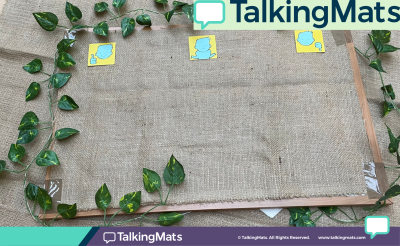
The approach taken in this project reflects that beautifully. Instead of relying on traditional methods, children were invited to share their views through drawing, conversation and interaction, using prompts such as ‘What do you like about play?’, ‘What sorts of things do you do when you are playing?’, ‘What helps you to play?’, and my personal favourite ‘What did you use to play with that you don’t play with now?’ These were not used rigidly, but as flexible provocations for the children’s drawings, with children then following their own agendas.
What stood out for me was how willing and enthusiastic children were to share. They didn’t need encouragement at all, they knew exactly what they wanted to communicate and how they wanted to express their views.
Their drawings and comments revealed consistent themes, including the importance of friends and family, imagination, creativity, physical activity, and the spaces available to them. There was also a strong sense of emotion running through their responses, with children connecting play to happiness, enjoyment and feeling good.
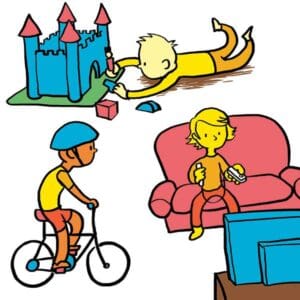
Some of the examples were just brilliant in their honesty and clarity! Children talked about building “comfortable things” like houses and castles, playing football because it is “with my friends”, making up games using their imagination, and simply needing “my hands to play” (which is absolutely true!) Others highlighted the role of family, sunshine, outdoor spaces and even digital play, showing just how broad and varied their experiences are. There were also glimpses into loss and transition, with children mentioning toys they no longer play with or activities they used to enjoy but don’t do now, it reminded me of Toy Story, when Buzz, Woody and the gang aren’t part of Andy’s everyday life.
What I found particularly interesting was the next stage, where, after the project team had identified themes from the children’s drawings, the graphic designer used the children’s drawings as inspiration for the ‘Talking Mats’ new symbols. These visuals were taken back to the children for feedback. Their responses were refreshingly direct! They preferred larger images, wanted colour, and were clear that they didn’t want to see objects on their own but children interacting with them.
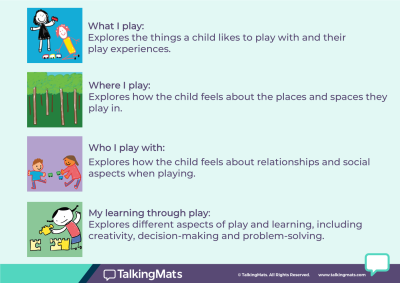
The final resource really reflects this process, with four main themes emerging, ‘What I play’, ‘Where I play’, ‘Who I play with’, and ‘My learning through play’. The inclusion of learning through play is particularly interesting for me as Play Pedagogy Lead at Play Scotland, as it invites children to begin reflecting on their own development.
Joanne McConnell’s experience of piloting the resource across nursery and primary settings really brought it to life. What came through strongly was how engaging and motivating the approach was for children. Children were drawn to the materials, curious about the process, and keen to take part, which says a lot about how accessible and inviting the resource is.
There were also clear examples of how this kind of approach can inform practice in meaningful ways. For example, one child placed reading in the “don’t like” category despite being on track academically, highlighting a need to focus on motivation and enjoyment rather than attainment alone. Other responses pointed towards planning opportunities, supporting transitions, contributing to additional support plans, and even identifying themes for group discussions or future learning experiences. This resource can also feed into ELC and school settings’ self-evaluation for self-improvement processes, as a way of gathering children’s views.
What stayed with me most, though, was not just the practical applications, but the reminder that children have rich, thoughtful and often very clear perspectives on their play. When we take the time to listen using approaches that align with how they communicate, we gain insights that we might otherwise miss entirely.
This resource feels like a really positive step in that direction. It offers a structured yet flexible way to support conversations, reflection and participation, while keeping children’s voices at the centre. More than that, it challenges us to think about how often we genuinely create space for those voices to be heard, and how willing we are to let them shape what happens next.
Share:


