By Fiona Kirkland, Play Pedagogy Lead
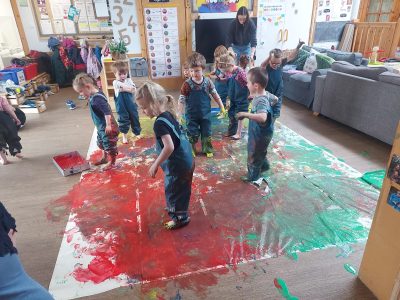
It has been a really exciting year for the Play Scotland Play Pedagogy Award, and it feels like the right moment to pause, take a breath and properly celebrate how far it has come!
We now have 75 schools signed up across 24 different local authorities in Scotland, as well as one independent school, which is quite something when I think back to where the Award started, the conversations that shaped it and the careful work that has gone into building it into what it is today.
The Play Pedagogy Award was developed by Play Scotland, working closely with Education Scotland and drawing on the knowledge and experience of school leaders, teachers, children, families and play pedagogy experts. It supports schools to reflect on, develop and evidence a whole school approach to play pedagogy through three phases, Plan, Play and Present, and across five strands: Leadership, Pedagogy and Curriculum, Learning Environment, Community and Professional Learning.
From the outset, the Award was never intended to be a quick fix, a box ticking exercise or a shiny trophy that sits on a shelf looking important, although, to be fair, I do love a bit of sparkle!
At its heart, the Award has always been about something much more meaningful. It recognises the thoughtful, committed work that teachers and school communities are doing to embed play pedagogy in ways that are right for their children, their staff, their families and their own context. It is about sustainable change, professional confidence, shared understanding and keeping children’s right to play, set out in Article 31 of the UNCRC, firmly connected to learning, wellbeing and everyday school life.
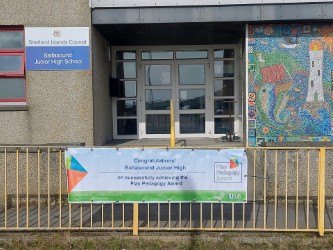
One of the biggest moments this year was seeing Baltasound Junior High School in Unst, Shetland, become the first school in Scotland to achieve the Play Scotland Play Pedagogy Award. Baltasound has been such a joy to work with, and their journey really shows what the Award is all about. Their work is rooted in strong leadership, staff commitment, children’s voice, community connection and a clear understanding that play is not something separate from learning. It is part of how children make sense of the world, develop skills, build relationships, take risks, solve problems and thrive.
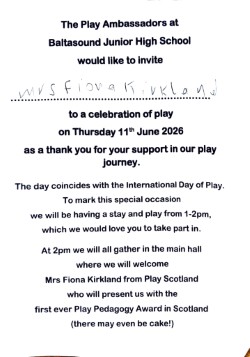
The Award was presented on the 11th of June 2026, which also marked the UN International Day of Play, adding an extra layer of meaning to an already very special celebration. The Play Ambassadors at Baltasound invited me to join their whole school Day of Play, and it was one of those moments that will stay with me for a very long time, and not only because I got to meet three real Vikings. Thank you Mrs F for that surprise! The day included a stay and play session, time with children, families and staff, and a gathering in the main hall for the official presentation of the first ever Play Pedagogy Award in Scotland. Their invitation, filled with children’s drawings, a strong sense of school pride and the very important promise that “there may even be cake”, captured the spirit of the day perfectly. It was full of children’s voices, warmth, belonging and a genuine sense that play is valued as an integral part of everyday school life.
Baltasound’s achievement was also recognised in the Scottish Parliament through motion S7M-00257, Baltasound Junior High School Receives the Play Scotland Play Pedagogy Award, lodged on the 3rd of June 2026 by Kristopher Leask MSP (Highlands and Islands, Scottish Green Party).
The motion congratulated Baltasound Junior High School in Unst on becoming the first school in Scotland to receive the Award, recognised this as a significant achievement for the school and wider community, and highlighted Shetland as leading the way in children’s rights, wellbeing and education. It also recognised the vital importance of play as part of children’s learning, wellbeing and development.
This was a really lovely moment of recognition, not only for Baltasound, but for the wider message that play belongs in serious conversations about education, children’s rights and the experiences children should have in school. We are also very grateful to the MSPs who supported the motion: Colin Beattie, Holly Bruce, Ariane Burgess, Maggie Chapman, Ross Greer, Alex Kerr, Fulton MacGregor, Cara McKee, Stuart McMillan, Laura Moodie, Kate Nevens, Mark Ruskell and Paul Sweeney. Their support helped shine a light on the strength of island schools and communities, showing that excellent practice in children’s rights, education and play pedagogy can lead the way from any part of Scotland.
The launch of the Play Pedagogy Award website has also been an important step forward, giving schools a clearer way to find out about the Award, understand the process and register their interest. As more schools come on board, the Award is becoming much more than a framework. It is becoming a growing community of educators and school communities who are learning from each other, sharing practice honestly and helping to build confidence around play pedagogy across Scotland.
It has also been incredibly encouraging to see a number of schools involved in the Play Pedagogy Award receive positive HMIE inspection reports. Across recent reports, inspectors have recognised many of the same things that the Award is designed to support, including learning through play, developing play pedagogy, rich indoor and outdoor environments, skilled adult interaction, observation, children’s choice, creativity, curiosity, independence, communication, collaboration, problem solving and confidence. These are important messages, because they show that play pedagogy is being recognised as part of wider conversations about high quality learning and teaching, school improvement and children’s outcomes.
Some inspection reports have highlighted staff developing shared understandings of learning through play, creating environments that nurture curiosity and creativity, and using observation thoughtfully to identify children’s next steps. Others have recognised more embedded approaches, where staff draw on professional learning, research, national guidance and school data to continually refine and strengthen their practice. Baltasound’s inspection findings were particularly powerful, with HMIE identifying highly effective approaches to implementing play pedagogy across the school as practice worth sharing more widely. That is a significant endorsement, and a meaningful recognition of the thoughtful, sustained work taking place across our PPA schools.
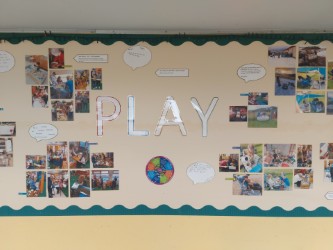
Other schools are now approaching the final stages of their Award journey, which is incredibly exciting. Each school has taken its own path, shaped by its community, its children, its staff team and its learning environment.
This is one of the Award’s real strengths. It does not ask schools to follow a single model or recreate someone else’s practice, it supports them to understand their own context, listen to children, build shared values and create meaningful, lasting change.
As the Play Pedagogy Award continues to grow, I hope it will give more schools the confidence to recognise play as a vital part of learning, not only in the early years but right across the whole school. This year has given us so much to celebrate, but it also feels like the start of the next stage of the journey. With more schools preparing to share their stories and others just beginning, there is a strong sense that the Award is helping to build something meaningful across Scotland, one school story at a time.
Play Pedagogy Award | Play Scotland
Share:


