
Erin is a play therapist and lecturer based in Scotland with a background in early years. Erin holds qualifications in Childhood Studies, Play Therapy, and Systemic Practice. She is passionate about advocating for play based approaches that honour children’s agency, rights, and wellbeing.
I am not the first person to advocate for more play within education, and I will not be the last. This
article outlines my reflections as a play therapist on why play belongs firmly within trauma informed practice.
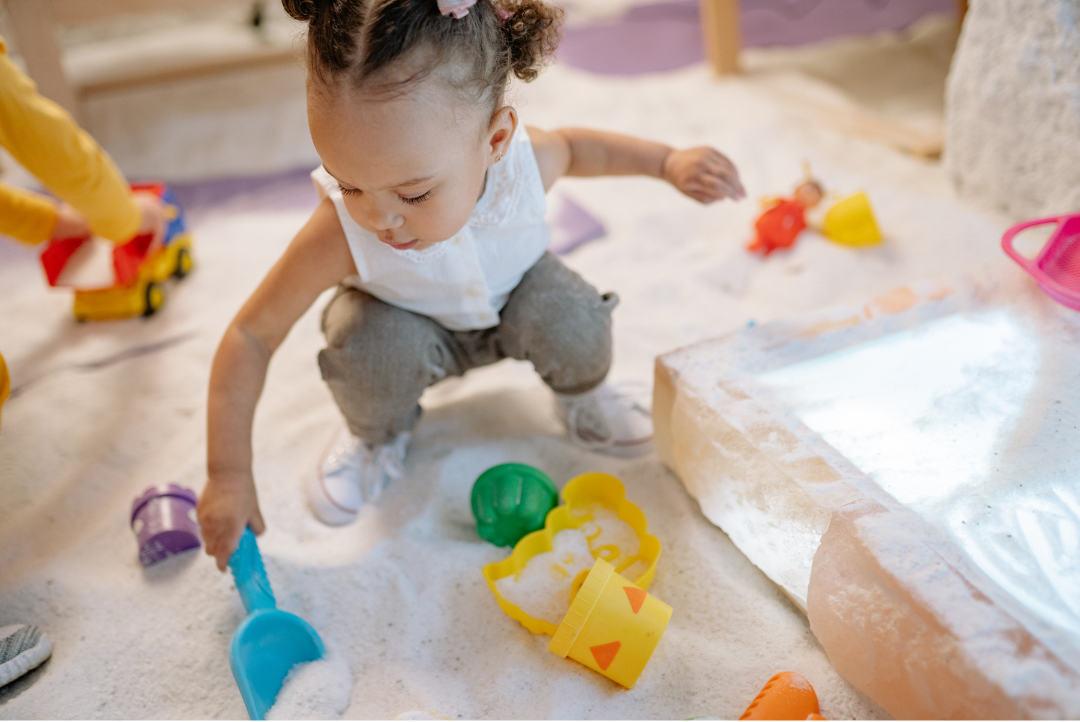
Play led and directed by children is essential for positive mental health, expressing emotion, and importantly processing and living with trauma. By play, I mean creativity in any form, self-directed, intrinsically motivated, cultivated by thoughtful resources and well-informed staff. Play and playfulness in its widest form, exists in everyone from toddlers to teenagers and well beyond.
Play and Child Development
Play and how children develop are impossible to untangle. In play children develop physically, practicing fine and large motor skills. Linguistic development happens in play when children practice and repeat language, using interesting words to describe sticky sensory experiences, the texture of nature, and everything in between. Play is vital for children as they develop socially and emotionally, creating intricate and complex social rules for imaginary games. In roleplay, children are developing empathy, stepping into the lives of others and imagining their experiences. Cognitive development is supported by problem solving in play and even sensory experiences.
Developmental Trauma
When a child experiences trauma, it is referred to as ‘developmental trauma’ meaning that what they have experienced has impacted an aspect of their development. Some areas of development are more fixed than others. How children learn to interoperate and engage with the world is individual and contextual. Emotional development, for most people is a lifelong journey. If professionals are going to meet children’s needs, treat them as individuals and work holistically, children who have experienced trauma need access to playful developmental experiences. It is possible that some children have been play deprived, maybe their family was under extreme stress and play wasn’t a priority. Maybe in play they can revisit a time when they felt safe. The benefits of play outweigh any negative if it is facilitated properly and understood by adults. Children develop socially through simple and complex play, initially playing parallel to other children before navigating play with their peers. Throughout childhood they engage in complex cooperative and imaginative play with rules, boundaries, exhilaration and disappointment. Healthy attachments are formed within play (Peekaboo). The type of play I am talking about is facilitated by professionals skilled in understanding the nuances of play and creating freedom within an appropriately flexible structure.
Play within Trauma Informed Practice
Trauma informed practice offers an environment and culture that recognises people who have experienced trauma need choice, safety, empowerment, collaboration, and trust, every day and in every situation. Especially where there is an imbalance of power. Authentic and appropriate choice for children who have experienced trauma needs to include play. Children make meaningful choices in their play, identifying preferences, finding out what motivates them, sparks their interests and what they like or don’t like. In doing this they are cultivating lifelong interests and importantly generating a sense of who they are as a person.
Trauma can impact a child or young person’s sense of physical and emotional safety. When people experience trauma within close relationships, it can impact their sense of control or agency over their own life. Play offers opportunities for appropriate control. As adults, we can support this by reframing what we see and allowing space for it. We scaffold a need for control with boundaries and understanding, offering opportunities for children to feel in charge of themselves in ways that make sense within their environment. Building emotional safety with children and young people can be done by observing, initiating, or with permission, joining in on their play. When adults enter a child’s world in this way, they are allowing the child to be appropriately in charge of the situation, creating feelings of predictability, safety and trust.
Empowerment in trauma informed practice is about strengths. In play children are exploring mastery. Play builds feelings of competency and a sense of success but the child is the one measuring it, this cultivates internal validation. Play builds the foundations of self-worth. By facilitating play, we are utilising a tool that children already use themselves. Being truly trauma informed in our approach means working in collaboration with children. Meeting children on their level. Play provides us with a way to really be there for a child, offering acceptance of them as they are, without imposing an adult idea of what they might need.
Play and Co regulation
Trauma has an impact on children’s ability to stay regulated, it does this to adults too.. Trauma can make it difficult to manage big emotions and most children need practice, facilitated by adults who understand co regulation. The core element of helping children develop emotional regulation is adults staying regulated around them in different situations. In play children can experience difficult emotions, failure, disappointment, jealousy and anger. Emotional regulation is practiced and experienced viscerally from the first time someone knocks down a tower of blocks or grabs the plastic banana that a child is enjoying chewing on. Frustration met with comfort and understanding, mediated by a regulated adult is co regulation and play offers a myriad of safe opportunities for practice, well beyond early years.
The role of the adult
If a child is struggling to engage with peers without being able to regulate themselves, they need an adult to stay regulated and help them to mediate this, sensitively balancing opportunities for play with others and opportunities for playing alone. If children’s opportunities for play are removed because they are struggling, it is equivalent to removing opportunities to read for a child struggling with literacy. That seems absurd, but that is what happens when children find it hard to play with their peers, play is often the first thing to go. Play opportunities for children who have experienced trauma need to extend beyond break and lunch time. They need to be expansive, creative, and most importantly inclusive. All children benefit from play. Children who have experienced developmental trauma might need time to play on their own, parallel play regardless of their age, or extended one to one time with adults because it is meeting their individual needs. They also need adults, educated about play and child development that are prepared to keep providing and scaffolding opportunities for them. In early years, a play environment is constantly evaluated and moved around to suit the needs of the children accessing it. This can change daily, termly or throughout the year. Staff observe how children are engaging with resources and each other then use their knowledge of play and child development to help them thrive. In early years, children’s wellbeing is evaluated by how deeply they are engaged in play that they have chosen themself.
Play Therapy and Universal practice
In child led play therapy, children express themselves by creating and deconstructing within a predictable framework of boundaries that are developmentally appropriate and flexible supported by a trained professional. Feelings can be released somatically, children express emotions they cannot articulate in abstract ways, smearing paint or releasing frustration on thick clay. Children can recreate a scene using figures and objects that express loneliness, fear, chaos or violence.
You do not have to be a play therapist or trauma expert to facilitate this as a universal tool. There will always be a space for direct therapeutic intervention in some cases, but given the prevalence of trauma, the ideal is a trauma informed therapeutic environment universally.
Play can help children to process trauma in their own personal and meaningful way. By re-enacting in a safe environment or using metaphors and imagination. What matters is that it is meaningful to the child and an adult is prepared to contain and facilitate it with thoughtful responses. Adults might never know what meaning play has, it might look like two growling dinosaurs, but to a child it could be a complex, subconscious and abstract representation of their inner world and the relationships they are experiencing around them. In play children are attuned with their own thoughts and feelings. They can represent, explore and process their core beliefs surrounding self, family and the world around them. Adults can support this by facilitating the environment and responding thoughtfully.
The window of Tolerance
The ‘Window of Tolerance’ metaphor tells us that people who have experienced trauma can have a narrower green zone and find it harder to regulate intense emotions. Our focus is often on helping children get back into their green zone after an escalation and a dip. What if our focus shifted to growing and expanding the green zone, ‘the window of tolerance’ for our children with co regulation and play. Let’s create playful experiences for children every day, where they feel safe, calm and connected. A space where they embody their creativity and feel truly themselves. Playful experiences, fun and joy for children who have had difficult times early in life should be our priority. Play belongs in Trauma Informed Practice because it makes developmental sense to facilitate these opportunities for children. The ethos of Trauma Informed Practice advocates for an environment that cultivates the opposite experiences to Trauma. Fun, safety, laughter, connection and personal agency, all found in play, create an environment that is in direct opposition to Trauma. This is the environment that children deserve, especially if trauma has impacted their life.
Reading
Axline, V.M. (1947) Play Therapy. Ballantine Books, New York.
Axline, V.M. (1964) Dibs in Search of Self. Ballantine Books, New York.
Landreth, G.L. (2023) Play Therapy. 4th edn, Routledge, London.
Crichton, V. et al. (2020) Realising the Ambition – Being Me: National Practice Guidance for Early Years in Scotland. Education Scotland, Livingston.
Cruz, D. (2022) Developmental Trauma: Conceptual Framework, Associated Characteristics, and Clinical Implications. Frontiers in Psychiatry. Available at: https://www.ncbi.nlm.nih.gov/pmc/articles/PMC9352895/
NHS Education for Scotland (2025) National Trauma Transformation Programme. Available at: https://www.nes.scot.nhs.uk/our-work/trauma-national-trauma-transformation-programme/
Scottish Government (2023) National Trauma Transformation Programme: Trauma-Informed Practice. Available at: https://www.gov.scot/publications/research-and-analysis/2023/11/national-trauma-transformation-programme-trauma-informed-maternity-services-pathfinders-learning-report/
Scottish Government (2025) Trauma-Informed Practice: Toolkit. Available at: https://www.gov.scot/publications/trauma-informed-practice-toolkit-scotland/
Siegel, D.J. (1999) The Developing Mind: How Relationships and the Brain Interact to Shape Who We Are. Guilford Press, New York.
Share:


