
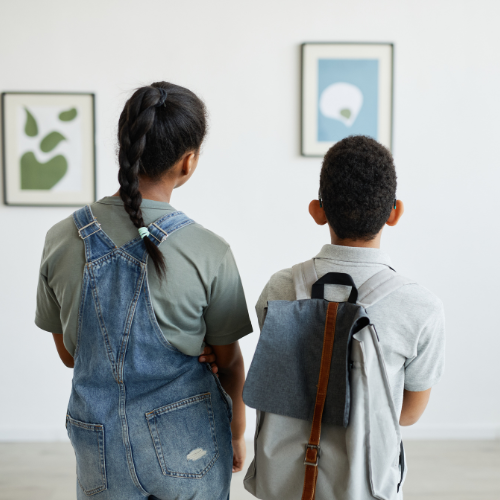
How giving young people permission to play might change the way we all experience art
– Phil Scott
In 2015, while leading arts education at Brampton Manor Academy in East London, I wrote for TES about taking pupils on a “Walk on the Wild side of Art”. At the time, I was interested in a relatively simple question: what happens when we stop telling young people how to look at art and instead give them permission to explore it for themselves?
Ten years later, that question has stayed with me. My work in art education was followed by several years working with Learning through Play at the LEGO Group, and more recently by research into how its principles might operate within contemporary curatorial practice. What began as a question about how young people encounter art has gradually become a broader question about how we create the conditions in which audiences are able to explore, question and make meaning for themselves.
Perhaps the issue isn’t simply how we encourage young people to engage with art. Perhaps it is how we create gallery environments in which playful engagement is possible in the first place. I was reminded of this recently when I visited Fruitmarket Gallery in Edinburgh with my daughter, Erika, to see Eva Rothschild’s The Void Presses The Wall (2026). The exhibition brings together work from across Rothschild’s career, and there is an unmistakable sense that the sculptures are not simply objects to be looked at from a respectful distance. Fruitmarket describes Rothschild’s practice as concerned with ‘sculpture’s ability to create bodily encounters in space, with some works requiring visitors to negotiate, move around and occupy them.’ One work in particular made me stop and reconsider the familiar gallery instruction: “Do Not Touch!” Amphi (2019) invites a different kind of relationship. Occupying a considerable space at the back of the upstairs gallery, its form encourages the body to move around and, importantly, to look differently. Climbing changes your height, your viewpoint and your relationship to the object and the gallery space. The sculpture becomes something to navigate rather than simply observe.
A playful experience does not necessarily require an activity, instructions or a button to press. This can be a difficult idea for galleries and museums, where play can often be perceived as chaotic or unpredictable. But if we think of play not as an activity, but as a feeling or outcome, we can begin to see how exhibitions might create the conditions for curiosity and engagement. Like a playground, the invitation is often enough: a suggestion that something can be explored, climbed, questioned or discovered. Sometimes, it requires something as simple as permission. What happens when we remove the instructions? Rothschild has been exploring the relationship between sculpture, play and physical encounter for some time. In Boys and Sculpture (2012), made for the Whitechapel Gallery’s Children’s Commission, a group of boys aged between six and twelve enter a gallery containing Rothschild’s sculptures. Initially they look, then touch. Eventually, they dismantle the sculptures, turning elements into objects for play, construction and further invention. The gallery describes the film as an exploration of the particularly physical relationship between young boys, their surroundings and the act of making. The result is fascinating precisely because there are no rules. No adults in the room telling them what the work means or how they should behave. As Andrea Schlieker observes in the Fruit Market catalogue of the exhibition, their conduct shifts from playful and mutually respectful to chaotic and destructive, resonating with a “Lord of the Flies scenario”. It would be easy to read this as an argument for why galleries need rules. I think it suggests something more interesting. It asks us to consider what becomes visible when the rules are temporarily removed.
From Sculpture to Playground, and Back again
Rothschild later developed this relationship between sculpture and physical play beyond the gallery. Parsloes Memphis (2021), created for Becontree in Dagenham, East London, consists of sculptural playground installations including two pyramids. Rothschild has described her intention in terms of sculpture being activated through “the body, through movement, irreverence, imagination and joy.”
In her new film Safe (2026), commissioned by Fruitmarket in collaboration with Sadler’s Wells, young people interact with these structures again. The film was made at the playground Parsloes Memphis and brings together young people, dancers and the sculptural playground. What interested me when watching Safe was not simply what the boys did, but how differently they experienced the same space. At times they occupy the sculpture together. At other times they separate, each discovering their own route, position or challenge. One climbs; another watches. One treats the structure as something to conquer; another appears absorbed in the physical sensation of occupying it.
The starting point is the same. The experiences are not. And perhaps this is one of the most important things we can learn from play. We do not all have to experience the same thing in the same way for an experience to be meaningful. What might this mean for galleries?
In my recent research into Learning through Play as a curatorial methodology, I explored five characteristics of play: Joyful, Meaningful, Socially Interactive, Actively Engaging and Iterative. What I found was that these qualities are not necessarily produced by making an exhibition “playful” in the conventional sense. They emerge through the conditions created around the artwork. A gallery can tell us what to think. It can tell us what something means. It can tell us where to stand. Or it can create an opportunity for us to ask a question.
The Rothschild exhibition does not simply present sculpture as something to look at, it creates encounters in which the body, imagination and personal experience become part of the process of looking. This is particularly evident in The Grit (2026), a commissioned work consisting of tie-dyed mattresses precariously balanced on a large granite boulder, rising almost to the ceiling of the gallery. I recall my daughter’s response as she first encountered it: for her, the work immediately evoked memories of The Princess and the Pea. For another visitor, its scale and precariousness might prompt wonder at the physics of the construction, for another, it might simply be the colour or unexpected combination of materials that creates the attraction. The most important part is that none of these responses is more valid than the other. This is where the relationship between play and art becomes particularly useful. Play rarely begins with everyone starting from the same place or pursuing the same outcome; it begins with an invitation and allows different possibilities to emerge. The Grit does something similar: it offers multiple ways into the work, allowing each visitor to decide what happens next. And this is exactly why we need to treat Play not necessarily as an activity, but as a condition.
A condition in which curiosity can emerge, where uncertainty is tolerated and where we can test possibilities without necessarily knowing what the outcome will be. And importantly, this isn’t only useful for children.
Galleries are Playgrounds for the Brain
German philosopher Walter Benjamin offers a beautiful way of thinking about this. In Berlin Childhood around 1900, he recalls riding a carousel as a child. As it revolves, the world appears, disappears and reappears around him. Familiar objects become strange and then familiar again. The carousel temporarily removes him from the ordinary position from which he understands the world. In my research I have begun to think about galleries in much the same way. Perhaps a good exhibition is a kind of playground for the brain.
We enter from one world and, for a short time, we inhabit another. We move, look, listen, remember, question, make connections and importantly reflect. We encounter the familiar from a different position and, when we leave, and return to the world outside perhaps we look at things slightly differently. The point is not that galleries should become literal playgrounds, but that they might learn from what playgrounds have long allowed us: explore, take risks, negotiate, imagine and discover on our own terms. Most of us have experienced this at some point in our lives; perhaps the challenge is to recognise that the impulse to play does not disappear simply because we grow up.
Let young people change the gallery
This brings me back to the proposition I made in my article from 2015. Taking young people into contemporary art spaces was never simply about making art more accessible to children. It was about recognising that young people can bring something into the gallery that adults sometimes lose: a willingness to investigate and be curious before asking whether they are doing it correctly. Rothschild’s work makes that proposition particularly visible. Her sculptures provide a starting point, but the experience is generated through what happens next.
The same sculpture can produce completely different encounters. The same space can become a place for climbing, conversation – interestingly Fiona Bradford and Eva Rothschild held there artists talk together on top of Amphi -, observation, challenge, solitude or collective play. And perhaps this is where galleries have an opportunity. Rather than asking: “How do we get young people to engage with art?” we might ask: “What could we change about the way we curate art so that young people and adults have more opportunities to engage on their own terms?” That is a subtle shift, but an important one. Because when we create spaces that allow young people to question, explore and make their own connections, we may discover that the resulting experience isn’t just better for them. It might be better for all of us.
 Phil Scott is an curator, artist and creative practitioner whose work sits at the intersection of contemporary art, design, education and Learning through Play. He holds an MA in Curating from Aarhus University, a BA in Product Design from Central Saint Martins and a PGCE in Art & Design from Goldsmiths University. His career spans arts education, contemporary curation and creative practice, including senior roles in arts education and nearly five years working within LEGO Design, where he developed programmes exploring creativity, design thinking and Learning through Play.
His curatorial practice encompasses exhibitions, publications, creative programmes and audience engagement, with a particular interest in how exhibitions can create conditions for curiosity, participation and independent meaning-making. His recent research explores Learning through Play as a potential curatorial methodology, asking how galleries and museums might encourage audiences to explore, question and make connections for themselves. His ongoing work brings together his experience in art, design, education and play to consider how cultural spaces can become more open, engaging and playful environments for everyone.
linkedin.com/in/phil-scott-creates
Share:


